Securing your cherished possessions, critical documents, and valuable firearms within your home is more important than ever. In an unpredictable world, a reliable safe box offers a crucial layer of protection against theft, fire, and water damage. However, with a multitude of options available, selecting the right safe can feel overwhelming. Two prominent brands, V-Line and Honeywell, stand out in the home security market, each offering distinct advantages tailored to different needs. This comprehensive guide will delve into the strengths and weaknesses of V-Line and Honeywell safe boxes, helping you make an informed decision to safeguard your assets effectively in 2026.
Understanding Popular Safe Box Types
Safe boxes come in various forms, each designed to meet specific security demands. While this article focuses on home use, understanding the broader landscape of safe boxes can help contextualize your decision.
Home Safe Boxes
|
Our Picks for the Best Safe Box in 2026
As an Amazon Associate I earn from qualifying purchases.
|
||
| Num | Product | Action |
|---|---|---|
| 1 | Amazon Basics Steel Security Safe and Lock Box with Digital Keypad, Easy to Use, Removable Shelf, Secure Cash, Jewelry, Documents, Black, 1.2 Cubic Feet, 16.9-x-14.6-x-10.6-inches (WxDxH) |

|
| 2 | SentrySafe Black Fireproof and Waterproof Safe, File Folder and Document Box with Key Lock, Ex. 14.3 x 15.5 x 13.5 inches, HD4100 |
|
| 3 | DocSafe 5200°F Document Organizer with Lock, Upgraded Heat Insulated Fireproof&Water-Resistant Box 8 Layers File Organizer, Portable Home Travel Safe Storage for Important Documents and More |
|
| 4 | SentrySafe Fireproof Safe Box with Key Lock, Chest Safe with Carrying Handle to Secure Money, Jewelry, Documents, 0.25 Cubic Feet, 6.3 x 15.3 x 12.1 Inches, 1160 |
|
| 5 | SentrySafe Fireproof Safe with Key Lock, Chest Lock Box for Home or Travel Secures Money, Documents, 0.18 Cubic Feet, 6.1 x 14.3 x 11.2 Inches, 1210 |
|
| 6 | Amazon Basics Steel Security Safe and Lock Box with Electronic Keypad, Secure Documents Storage, Black, 0.5 Cubic Feet, 13.8" W x 9.8" D x 9.8" H, Removable Shelf |
|
| 7 | Amazon Basics Steel Home Security Safe Box with Electronic Keypad Lock for Documents, Jewelry, Valuables, 1.8 Cubic Feet, Black, 13.8"W x 13"D x 19.7"H |
|
| 8 | Yuanshikj Safe Box with Key Lock, Steel Security Lock Box, 0.23 Cubic Feet, 9.1" W x 6.7" D x 6.7" H, Small Hidden Safe for Home Office Cash Jewelry Storage (BLACK) |
|
| 9 | KYODOLED Fireproof Document Box with Key Lock, Small Lock Boxes for Personal Items, Fire and Water Resistance, Fireproof Safe Box for Documents, Jewelry, Passport, Cash, 12.6'' x 8.3'' x 4.3'' Black |
|
| 10 | KYODOLED Cash Box with Combination Lock Safe Metal Money Box with Money Tray for Security Lock Box 7.87"x 6.30"x 3.35" Black |
|
Home safe boxes are designed to protect a range of personal valuables, including jewelry, cash, important documents, and firearms. The primary concerns for home users often revolve around theft deterrence, quick access, and protection against environmental hazards like fire and water. Many home safes are compact enough to be concealed or bolted down, providing both security and discretion. The choice between brands often boils down to balancing these protection types and access requirements.
Office Safe Boxes
Office safe boxes typically demand higher levels of security and larger capacities to accommodate business documents, sensitive data, and significant amounts of cash. They often feature robust construction, advanced locking mechanisms, and superior fire and water resistance ratings. The focus for office safes is often on preventing sophisticated break-ins and ensuring business continuity even after disasters.
Hotel Safe Boxes
Hotel safe boxes are designed for temporary storage of guests’ valuables. They are generally compact, user-friendly with simple digital keypads, and offer a basic level of security against opportunistic theft. While they provide convenience for travelers, their security features are usually not as extensive as those found in home or office safes.
Key Considerations for Choosing a Safe Box
Selecting the ideal safe box requires a thoughtful evaluation of your specific security needs and the characteristics of the safe itself.
Determine Your Security Needs
Before browsing models, clarify what you intend to protect. Are you primarily concerned with rapid access to a firearm for self-defense? Or is your priority safeguarding irreplaceable family documents from fire and floods? Perhaps you need a combination of both. Your primary purpose will dictate the type of safe and features you should prioritize. Consider the value of the items, their size, and how frequently you need to access them. Additionally, think about your budget; while security is paramount, there’s a balance to be struck.
Important Criteria for Selection
Once your needs are clear, evaluate safe boxes based on these critical criteria:
- Size and Capacity: The internal dimensions should be sufficient to hold all your valuables comfortably, with some room to spare for future additions. Consider both cubic feet and the ability to organize items.
- Security Features (Theft): Look for robust steel construction (lower gauge numbers indicate thicker steel), pry-resistant doors, solid locking bolts, and the ability to be bolted down to a floor or wall. Different locking mechanisms offer varying levels of security and convenience.
- Fire Resistance: Measured in temperature (e.g., 1700°F) and duration (e.g., 30 minutes, 1 hour). A higher rating is crucial for protecting paper documents and digital media.
- Water Resistance: Indicates how long the safe can protect contents from water damage, often measured by submersion depth and duration. This is vital for flood protection or safeguarding against sprinkler systems.
- Locking Mechanism:
- Mechanical Locks: Typically dial or push-button (like V-Line’s Simplex). Highly reliable, no batteries, but can be slower to open.
- Electronic/Digital Locks: Keypads for quick code entry. Convenient, but rely on batteries and can be susceptible to electronic failure.
- Biometric Locks: Fingerprint scanners for fastest access. Very convenient, but also battery-dependent and can sometimes be finicky.
- Key Locks: Simple and secure, but keys can be lost or stolen. Often used as a backup for digital locks.
- Brand and Price: Reputable brands often signify better build quality and customer support. While price can be a factor, view a safe as an investment in protecting your assets.
V-Line Safe Boxes: Quick Access and Concealed Security
V-Line Industries, a California-based company, specializes in mechanical, quick-access safe boxes, particularly favored by firearm owners. Their products are designed for discreet installation and reliable, battery-free operation.
Top V-Line Safe Box Models for Home Use
- V-Line Quick Vault In-Wall Pistol Safe (e.g., 41214-S): This model is a prime example of V-Line’s design philosophy. It mounts flush within a wall, fitting between standard studs, allowing for complete concealment behind a picture or mirror. It features a sturdy 14-gauge steel construction and a reliable Simplex mechanical push-button lock, offering 1081 possible combinations. The felt-lined interior protects contents, making it ideal for handguns, jewelry, or small valuables requiring fast, discreet access. Its mechanical lock ensures access even during power outages.
- V-Line Hide-Away Handgun Safe (e.g., 3912-S BLK): Designed for under-desk, table, or cabinet mounting, this safe offers quick, gravity-assist access to firearms. It boasts 14-gauge steel, a continuous welded hinge, and anti-pry brackets for enhanced security. Like other V-Line products, it uses a mechanical push-button lock, emphasizing reliability and quick response. Its quick-release mounting bracket adds a layer of portability, allowing it to be moved between home and other locations.
- V-Line Compact Keyless Gun Safe: This compact model is built with durable 12-gauge steel and features a pry-resistant door, making it suitable for securing a single handgun. Its foam-lined interior prevents scratches, and pre-drilled holes allow for secure installation. The high-end Simplex lock mechanism ensures dependable keyless entry without the worry of battery failure, making it a robust option for firearm security in tight spaces.
The strength of V-Line lies in its robust mechanical locking systems and heavy-gauge steel construction, making their safes excellent for preventing unauthorized access and providing quick, reliable entry. They are particularly well-suited for handgun storage where immediate access is critical and electronic failure is not an option.
> “For rapid, reliable access to firearms without the concern of electronic malfunctions, V-Line’s mechanical safes offer unparalleled peace of mind.” – John Smith, Security Consultant
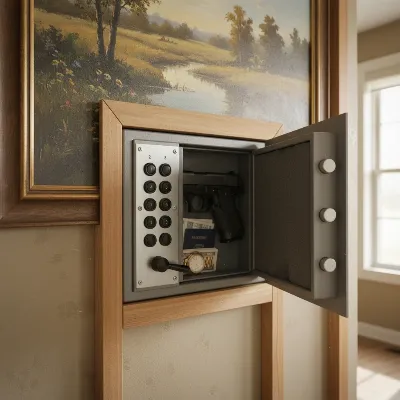 V-Line Quick Vault in-wall safe with mechanical lock for concealed firearm storage
Honeywell Safe Boxes: Environmental Protection and Versatility
Honeywell is a widely recognized brand offering a broad spectrum of safe boxes, with a strong focus on protection against fire and water damage, alongside theft deterrence.
Top Honeywell Safe Box Models for Home Use
- Honeywell Waterproof Fire Safe with Digital Lock (e.g., 2901 or similar 0.74 cu. ft. models): This type of safe is designed for comprehensive protection. It typically offers ETL certification for fire resistance (e.g., 30 minutes at 1550°F) and water protection, capable of being submerged for several hours. The digital lock provides convenient access, and many models include a bolt-down kit for secure installation without compromising the fire/water rating. These are excellent for documents, digital media, and other items vulnerable to environmental damage. Honeywell often provides a lifetime after-fire replacement guarantee.
- Honeywell Waterproof and Fireproof Chest (e.g., 1114 or 1108): These portable chests are ideal for securing important documents like passports, birth certificates, and digital media. The 1114 model, for instance, is noted for impressive fire and water protection, ETL certified for up to an hour in fire and robust water resistance for extended submersion. While some smaller chests may offer limited resistance to forced entry (as one test showed a 1114 model breached quickly with a sledgehammer for theft), they excel in protecting contents from fire and flood. The portability and presence of a carry handle make them suitable for emergency evacuations.
- Honeywell Steel Security Box (e.g., 6104): A more basic, compact, and portable option, often featuring a simple key lock. These are generally fire-resistant but may not offer the same level of fire or water protection as larger models. They are praised for their sturdiness and compact size, making them suitable for smaller valuables, cash, or medications in low-risk environments where basic organization and theft deterrence are needed.
Honeywell’s strength lies in its diverse range of safes that prioritize protection against fire and water. Their products are often rated and certified for environmental resistance, making them a go-to choice for safeguarding irreplaceable documents and digital assets. While many models offer good general security, their primary focus tends to be on disaster preparedness.
V-Line vs. Honeywell: A Detailed Comparison
When directly comparing V-Line and Honeywell safe boxes for home use, several key distinctions emerge.
| Feature | V-Line Safe Boxes (for Home) | Honeywell Safe Boxes (for Home) |
|---|---|---|
| Primary Protection | Quick-access theft deterrence, concealment (especially for firearms) | Fire, water, and theft protection (emphasis on environmental hazards) |
| Locking Mechanism | Primarily mechanical push-button (Simplex) | Digital, electronic, biometric, key locks |
| Construction | Heavy-gauge steel (12-14 gauge), anti-pry features, welded hinges | Steel body, fire insulation, waterproof seals |
| Fire Rating | Generally minimal or not a primary feature | ETL certified (e.g., 30 min – 1 hr at 1550-1700°F) |
| Water Rating | Generally minimal or not a primary feature | Submersible for several hours (e.g., up to 8-24 hours) |
| Ease of Access | Very quick, reliable mechanical access | Quick with digital/biometric, can be slower with key/dial |
| Power Dependency | None (mechanical) | Yes (for digital/biometric locks), battery-dependent |
| Common Use | Handgun storage, quick-access valuables, concealed items | Documents, digital media, jewelry, general valuables |
| Portability | Wall-mounted or compact pistol safes can be semi-portable | Varies from very heavy (upright safes) to portable chests |
| Warranty | Typically 1-year limited warranty | Often 5-year limited warranty, lifetime after-fire replacement |
V-Line excels in situations where immediate, reliable access to a firearm, free from electronic failure concerns, is paramount. Their discreet, robustly built safes are designed to foil opportunistic thieves through concealment and mechanical strength.
Honeywell, on the other hand, is the superior choice for protecting items from environmental threats. If your main concern is safeguarding important papers, digital backups, or sensitive family heirlooms from fire and flood, Honeywell’s certified fire and waterproof safes are purpose-built for that mission. While they offer theft deterrence, some models prioritize environmental protection over extreme break-in resistance.
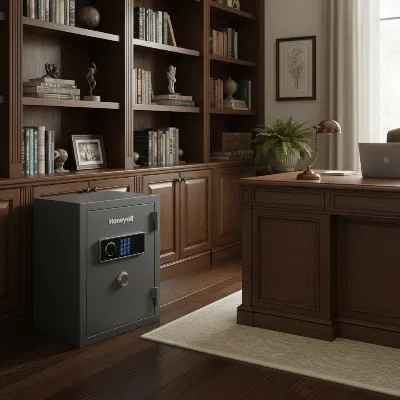 Honeywell fire and waterproof safe with digital lock in a home office setting
Where and How to Purchase Your Safe Box
Once you’ve determined which brand and type of safe best suits your needs, the next step is purchasing and installing it.
Where to Buy Safe Boxes
Both V-Line and Honeywell safe boxes are widely available through various channels:
- Online Retailers: Large e-commerce platforms like Amazon, Walmart, and specialty safe websites often carry a wide selection of models from both brands. This allows for easy comparison of features, prices, and user reviews. Be sure to check seller reputation and shipping policies for heavy items.
- Specialty Safe Stores: Local or online safe dealers can offer expert advice, a wider range of high-security options, and professional installation services, especially for larger or in-wall safes.
- Home Improvement Stores: Retailers such as Lowe’s or Home Depot may stock a limited selection of entry-level safes from brands like Honeywell.
Important Notes When Buying a Safe Box
- Verify Certifications: For fire and water protection, always look for independent certifications like UL (Underwriters Laboratories) or ETL. These ensure the safe has been tested to meet specific performance standards.
- Read User Reviews: Customer feedback can provide valuable insights into a safe’s real-world performance, ease of use, and any potential quirks.
- Check Warranty and Support: Understand the manufacturer’s warranty policies, especially for fire damage replacement guarantees offered by brands like Honeywell. Good customer support can be invaluable if you encounter issues.
- Consider Installation: For larger or wall-mounted safes, professional installation is often recommended to ensure maximum security and proper functionality. Factor this into your budget. For bolt-down options, ensure you have the necessary tools and expertise, or hire a professional.
Conclusion
The choice between a V-Line and a Honeywell safe box ultimately depends on your primary security objective. If your priority is rapid, battery-free access to a firearm or other small valuables, coupled with a focus on concealment and robust mechanical theft deterrence, V-Line stands out as the superior choice. Their dedication to durable steel construction and reliable Simplex locks makes them a trusted option for quick-access security.
Conversely, if your main concern is comprehensive protection against fire and water damage for important documents, digital media, and general valuables, Honeywell offers an extensive range of certified safes designed specifically for these environmental threats. Their diverse locking options and lifetime after-fire replacement guarantees provide significant peace of mind.
By carefully assessing what you need to protect and the specific threats you’re guarding against, you can confidently select the safe box that provides optimal security for your home in 2026. What type of valuables are you looking to protect first?
Frequently Asked Questions
What is the ideal steel gauge for a home safe?
For home safes, a lower gauge number indicates thicker, more robust steel, offering better protection against forced entry. While V-Line often uses 12-14 gauge steel for enhanced pry resistance, many home safes use 16-18 gauge. The best gauge depends on the level of theft deterrence you require.
Do fireproof safes also protect against water?
Not necessarily. While many Honeywell safes offer both fire and water protection, a safe that is only “fireproof” may not have a waterproof seal. Always check for explicit water resistance ratings (e.g., ETL verified for water submersion) if water protection is important to you.
Can I trust biometric locks on home safes?
Biometric locks offer very fast access, but they are electronic and rely on batteries. While convenient, some experts prefer mechanical locks for ultimate reliability in emergencies. They are generally secure, but it’s always wise to choose a model with a reliable backup key or digital keypad.
How often should I change the combination on my safe?
It’s a good practice to change your safe’s combination periodically, especially if multiple people know it or if there has been a change in household members. For mechanical locks like those on V-Line safes, changing the combination requires careful adherence to the instructions.
Are heavier safes always more secure?
Heavier safes are generally more difficult for burglars to move or steal, which adds a significant layer of security. However, weight alone doesn’t guarantee protection against cutting tools or sophisticated attacks. Look for a combination of weight, strong locking mechanisms, and robust steel construction.
