The quiet security of a hidden space, a secret sanctuary for your most treasured possessions, offers unparalleled peace of mind in an unpredictable world. While traditional safes provide visible deterrence, the true genius of a hidden wall safe box lies in its invisibility. These ingenious devices transform an ordinary wall into a covert vault, keeping valuables not just locked away, but completely out of sight and out of mind for anyone but you. If you are looking to safeguard important documents, cherished heirlooms, emergency cash, or even small firearms, a well-chosen hidden wall safe provides a superior layer of discreet protection against opportunistic theft.
Understanding Hidden Wall Safe Boxes
Hidden wall safe boxes are purpose-built security containers designed to be recessed directly into the wall cavity of a home or office. Unlike freestanding safes that occupy floor space and are often easily identifiable, wall safes are engineered to fit snugly between standard wall studs, typically 16 inches apart on-center. Once installed, their flush-mount design allows them to be completely concealed behind everyday objects such as paintings, mirrors, sliding panels, or even false air vents. This clandestine placement is their primary security feature, as burglars cannot steal what they cannot find.
These safes offer a unique blend of security and discretion. They integrate seamlessly into your living space, making them an ideal solution for those who prioritize aesthetic harmony alongside robust protection. The installation process typically involves cutting an opening in the drywall, securing the safe to the wall studs, and then finishing the area to create a flawless, hidden access point. The sheer time it takes for a potential intruder to locate such a safe, let alone attempt to open it, often deters them entirely, aligning with the philosophy that “if they can’t find it, they can’t steal it.”
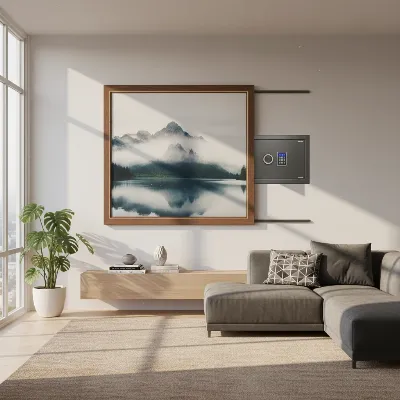 A hidden wall safe seamlessly integrated behind a large framed painting in a modern living room, emphasizing discreet security and home aesthetics.
Key Features to Consider for Hidden Wall Safe Boxes
Choosing the right hidden wall safe requires careful consideration of several critical features that contribute to its overall security, usability, and integration with your home.
Construction and Durability
|
Our Picks for the Best Safe Box in 2026
As an Amazon Associate I earn from qualifying purchases.
|
||
| Num | Product | Action |
|---|---|---|
| 1 | Amazon Basics Steel Security Safe and Lock Box with Digital Keypad, Easy to Use, Removable Shelf, Secure Cash, Jewelry, Documents, Black, 1.2 Cubic Feet, 16.9-x-14.6-x-10.6-inches (WxDxH) |

|
| 2 | SentrySafe Fireproof Safe Box with Key Lock, Chest Safe with Carrying Handle to Secure Money, Jewelry, Documents, 0.25 Cubic Feet, 6.3 x 15.3 x 12.1 Inches, 1160 |
|
| 3 | Yuanshikj Safe Box with Key Lock, Steel Security Lock Box, 0.23 Cubic Feet, 9.1" W x 6.7" D x 6.7" H, Small Hidden Safe for Home Office Cash Jewelry Storage (BLACK) |
|
| 4 | SentrySafe Black Fireproof and Waterproof Safe, File Folder and Document Box with Key Lock, Ex. 14.3 x 15.5 x 13.5 inches, HD4100 |
|
| 5 | DocSafe 5200°F Document Organizer with Lock, Upgraded Heat Insulated Fireproof&Water-Resistant Box 8 Layers File Organizer, Portable Home Travel Safe Storage for Important Documents and More |
|
| 6 | Amazon Basics Steel Security Safe and Lock Box with Electronic Keypad, Secure Documents Storage, Black, 0.5 Cubic Feet, 13.8" W x 9.8" D x 9.8" H, Removable Shelf |
|
| 7 | KYODOLED Fireproof Document Box with Key Lock, Small Lock Boxes for Personal Items, Fire and Water Resistance, Fireproof Safe Box for Documents, Jewelry, Passport, Cash, 12.6'' x 8.3'' x 4.3'' Black |
|
| 8 | Amazon Basics Steel Home Security Safe Box with Electronic Keypad Lock for Documents, Jewelry, Valuables, 1.8 Cubic Feet, Black, 13.8"W x 13"D x 19.7"H |
|
| 9 | SentrySafe Fireproof Safe with Key Lock, Chest Lock Box for Home or Travel Secures Money, Documents, 0.18 Cubic Feet, 6.1 x 14.3 x 11.2 Inches, 1210 |
|
| 10 | KYODOLED Cash Box with Combination Lock Safe Metal Money Box with Money Tray for Security Lock Box 7.87"x 6.30"x 3.35" Black |
|
The integrity of a wall safe largely depends on its construction. Look for safes made from heavy-gauge steel, typically 12-gauge or thicker for the body and door. A pry-resistant door and robust locking bolts are essential to withstand forced entry attempts. Some advanced models may also feature solid steel deadbolts and re-lockers that engage if the lock mechanism is attacked. The thickness of the steel, especially for the door, directly correlates with its resistance to cutting and prying tools.
Locking Mechanisms
The method of access is a crucial factor in both security and convenience.
- Key Locks: Traditional and reliable, but the key itself must be stored securely.
- Electronic Keypads: Offer quick access with a programmable code and often include an emergency override key. Look for illuminated keypads for low-light conditions.
- Biometric (Fingerprint) Locks: Provide the fastest access, ideal for situations requiring immediate retrieval, such as for firearms. They can store multiple fingerprints and usually come with backup keys or an emergency keypad.
- Combination Dials: Classic and mechanical, requiring no batteries, but can be slower to open.
Fire and Water Resistance
While not all wall safes offer fire or water protection due to their in-wall design, it’s a valuable feature for protecting documents, digital media, and other items susceptible to environmental damage. Fireproof wall safes typically have insulated steel panels and fire-rated doors, often rated for 30 minutes to one hour at specific temperatures. Water resistance might protect against minor leaks but is less common for full submersion. Note that fireproof wall safes are often deeper, requiring more space behind the wall.
Size, Depth, and Capacity
Consider what you intend to store. Wall safes come in various dimensions. Standard wall depths are usually 4 or 6 inches, which dictates the safe’s maximum depth. Fireproof models may require a deeper wall cavity, sometimes 12 to 15 inches, or installation in specific areas like back-to-back closets. Internal dimensions, including adjustable shelves and key hooks, determine the usable capacity for your valuables.
Installation Requirements
Most wall safes are designed to fit between standard 16-inch on-center wall studs. Ensure you measure your wall studs before purchase. Some safes come with a flange to cover the edges of the cut-out, simplifying installation and reducing the need for extensive drywall repair. Proper anchoring to the wall studs is paramount for security.
Top 5 Hidden Wall Safe Boxes for Secret Storage
When it comes to safeguarding your valuables with discretion, these hidden wall safe boxes stand out for their robust security, innovative features, and ability to blend seamlessly into any environment.
1. AMSEC WFS149E5LP Fireproof Wall Safe
The AMSEC WFS149E5LP is a top-tier choice for those prioritizing both concealment and fire protection. This safe is lauded for its robust construction, featuring a solid 1/2-inch thick door and heavy-duty locking boltwork designed to resist pry attacks. It boasts a UL-listed one-hour fire rating, ensuring that important documents and heat-sensitive valuables are protected from extreme temperatures. The safe utilizes an ESL5LP Digital Electronic Lock, offering convenient and secure access with a programmable code. Due to its significant fireproofing, it requires a deeper installation space, typically around 15.38 inches behind the wall, making it suitable for areas with ample wall depth. Inside, it includes a removable tray and an adjustable shelf for efficient organization of items.
2. Barska AX12038 Biometric Wall Safe
For quick, secure access, the Barska AX12038 Biometric Wall Safe is an excellent option. This safe is frequently recommended for its straightforward installation and user-friendly biometric fingerprint technology. It is designed to fit between standard wall studs and can be easily concealed behind a picture, mirror, or even furniture. The biometric lock allows for the storage of multiple fingerprints, providing rapid access without the need to remember codes or carry keys. Constructed from solid steel with a two-point deadbolt system, it offers substantial protection against tampering. The AX12038 also comes with emergency override keys, ensuring access even if batteries fail or fingerprints are not recognized. Its reliable performance and ease of use make it a popular choice for homeowners.
3. Viking Security Safe VS-52BLX Hidden In-Wall Biometric Safe
The Viking Security Safe VS-52BLX offers a dual-layer of security with both biometric and digital keypad access. This model can store up to 32 different fingerprints for quick, authorized entry and also allows for a programmable 4-8 digit code. In case of emergency or forgotten codes, it includes override keys. The safe features solid steel construction with a pry-resistant door and a motorized deadbolt locking system. Designed to fit discreetly within your wall, the VS-52BLX includes key hooks on the door and three adjustable shelves, making it versatile for organizing various valuables such as jewelry, cash, and small firearms. Its combination of advanced locking technology and thoughtful interior design provides exceptional security and convenience.
4. Gardall WMS129-G-E Fireproof Wall Safe
Another highly-regarded fireproof option, the Gardall WMS129-G-E, provides serious protection against fire alongside its concealed design. This wall safe is equipped with a UL 350-degree One Hour Fire Label, signifying its ability to protect contents from fire for an extended period. Like other fire-rated safes, it requires considerable depth (around 15.25 inches) behind the wall for proper installation. The WMS129-G-E comes with an electronic lock for secure access and a flange that helps achieve a clean, flush installation between wall studs. A standard pull-out tray inside aids in organizing smaller items, making it suitable for documents, media, and other fire-sensitive valuables. Gardall is known for its robust construction, and this model lives up to that reputation.
5. SnapSafe 75414 Tall In-Wall Safe
For those needing more vertical storage, the SnapSafe 75414 Tall In-Wall Safe presents a unique and versatile solution. Designed to fit within a standard 4-inch wall depth, this tall safe (44 inches high) is ideal for storing longer items, including rifles or multiple firearms, while remaining completely hidden. It features five removable shelves, allowing users to customize the interior layout to accommodate various valuables, from documents to jewelry, or to remove shelves for larger objects. The safe’s door can be oriented for left or right opening, providing flexibility during installation. While it focuses on robust physical security and concealment within a standard wall, it is important to note that it typically does not offer fire protection, making additional fireproof bags advisable for sensitive contents.
Comparing Top Hidden Wall Safe Boxes
| Feature | AMSEC WFS149E5LP | Barska AX12038 | Viking VS-52BLX | Gardall WMS129-G-E | SnapSafe 75414 |
|---|---|---|---|---|---|
| Lock Type | Digital Electronic | Biometric | Biometric + Digital | Digital Electronic | Keypad (Electronic) |
| Fire Rating | UL 1-Hour | No | No | UL 1-Hour | No |
| Wall Depth Req. | ~15.38 inches | Fits standard studs | Fits standard studs | ~15.25 inches | 4 inches |
| Construction | Heavy-gauge steel, 1/2″ door | Solid steel | Solid steel, pry-resistant | Heavy-duty steel | Heavy-gauge steel |
| Concealment | Behind art/mirror | Behind art/mirror | Behind art/mirror | Behind art/mirror | Behind art/mirror/door |
| Interior | Tray, adjustable shelf | Removable shelves | Key hooks, 3 shelves | Pull-out tray | 5 removable shelves |
| Key Benefit | High fire protection | Quick biometric access | Dual-access security | Robust fire protection | Tall, versatile storage |
Guide to Purchasing Your Ideal Hidden Wall Safe
Selecting the perfect hidden wall safe requires careful planning and a clear understanding of your specific needs to ensure maximum security and seamless integration into your home.
Assessing Your Needs
Begin by determining what items you intend to store and their value. This will help you decide on the required size, internal capacity, and the necessary level of security. Consider whether fire or water protection is crucial for your documents or media. Also, think about who needs access to the safe and how quickly. Biometric locks are excellent for immediate access, while electronic keypads offer convenience for multiple users. Lastly, establish a realistic budget, understanding that higher security features and certifications often come with a higher price point.
Installation Considerations
Before making a purchase, measure the spacing of your wall studs (typically 16 inches on-center) and the available depth within your wall cavity. Standard interior walls are usually 4 to 6 inches deep, but fire-rated safes often require more. If your walls are shallower, you might need to consider a different type of hidden safe or explore custom installation options. While many wall safes are designed for DIY installation, especially those with pre-drilled mounting holes and flanges, consider professional installation for heavier or more complex models to ensure optimal security and structural integrity.
Where to Purchase and What to Look For
Reputable safe and vault stores, both online and physical, are excellent sources. Brands like AMSEC, Barska, Viking, Gardall, and SnapSafe are well-regarded in the industry. When purchasing, always check for certifications such as UL ratings for fire and burglary resistance. Read product reviews to gauge real-world performance and reliability. Verify the warranty and customer support offered by the manufacturer. Remember that the goal is not just to buy a safe, but to invest in a discreet security solution that offers lasting peace of mind.
> “The best safe is the one a burglar never finds. Hidden wall safes excel in this aspect, turning surprise into your ultimate defense.” – John Chambers, Security Consultant
Conclusion
Hidden wall safe boxes offer a sophisticated and effective solution for safeguarding your most precious belongings. By integrating discreetly into your home’s structure, they provide a powerful deterrent against theft, relying on invisibility as their first line of defense. Whether you prioritize rapid biometric access, robust fire protection, or versatile storage for larger items, there is a hidden wall safe designed to meet your specific security needs. Investing in one of these concealed guardians not only protects your valuables but also brings an invaluable sense of peace, knowing that your secrets are securely kept within the very fabric of your home.
Are you ready to transform a simple wall into your personal, unseen vault?
Câu Hỏi Thường Gặp
What is the primary benefit of a hidden wall safe over a traditional safe?
The primary benefit is concealment. Hidden wall safes are recessed into the wall and disguised, making them virtually undetectable to an intruder compared to a visible, freestanding safe. This element of surprise is a significant deterrent to theft.
Can hidden wall safes offer fire and water protection?
Yes, some hidden wall safes are specifically designed with fire-resistant insulation, offering protection for documents and other valuables for a specified duration (e.g., 30 minutes to 1 hour). Water protection is less common for in-wall safes but some models may offer basic resistance against moisture.
How easy is it to install a hidden wall safe?
Many hidden wall safes are designed for straightforward installation between standard 16-inch on-center wall studs, often with pre-drilled holes and flanges. However, depth requirements, structural considerations, and the need for a clean finish can make professional installation advisable, especially for heavier or fire-rated models.
What types of locking mechanisms are available for hidden wall safes?
Common locking mechanisms include traditional key locks, electronic keypads with programmable codes, and advanced biometric (fingerprint) scanners for quick access. Many electronic and biometric safes also include emergency override keys for backup.
What should I hide my hidden wall safe behind?
Popular concealment methods include hanging a painting or mirror over the safe, placing it behind a piece of furniture that sits flush against the wall, or integrating it behind a false vent or sliding panel. The goal is to make the safe blend seamlessly with its surroundings.
