Discovering your safe box is locked with no key or forgotten combination can be a truly frustrating experience, turning a secure storage solution into an impenetrable barrier. Whether it holds important documents, sentimental valuables, or emergency funds, gaining quick access is often paramount. This comprehensive guide will walk you through various methods to open a locked safe box without a key, covering different safe types, assessing the situation, and when it’s best to call in professional expertise. By understanding the mechanics and the risks involved, you can approach this challenge with confidence and make informed decisions to retrieve your cherished possessions.
Common Safe Box Types and Their Opening Challenges
The method you employ to open a locked safe box without a key depends significantly on the type of safe and its locking mechanism. Different designs offer varying levels of security and present unique challenges for unauthorized or emergency access.
Home Safe Boxes
|
Our Picks for the Best Safe Box in 2026
As an Amazon Associate I earn from qualifying purchases.
|
||
| Num | Product | Action |
|---|---|---|
| 1 | Amazon Basics Steel Security Safe and Lock Box with Electronic Keypad, Secure Documents Storage, Black, 0.5 Cubic Feet, 13.8" W x 9.8" D x 9.8" H, Removable Shelf |

|
| 2 | Yuanshikj Safe Box with Key Lock, Steel Security Lock Box, 0.23 Cubic Feet, 9.1" W x 6.7" D x 6.7" H, Small Hidden Safe for Home Office Cash Jewelry Storage (BLACK) |
|
| 3 | SentrySafe Fireproof Safe with Key Lock, Chest Lock Box for Home or Travel Secures Money, Documents, 0.18 Cubic Feet, 6.1 x 14.3 x 11.2 Inches, 1210 |
|
| 4 | KYODOLED Cash Box with Combination Lock Safe Metal Money Box with Money Tray for Security Lock Box 7.87"x 6.30"x 3.35" Black |
|
| 5 | Amazon Basics Steel Home Security Safe Box with Electronic Keypad Lock for Documents, Jewelry, Valuables, 1.8 Cubic Feet, Black, 13.8"W x 13"D x 19.7"H |
|
| 6 | KYODOLED Fireproof Document Box with Key Lock, Small Lock Boxes for Personal Items, Fire and Water Resistance, Fireproof Safe Box for Documents, Jewelry, Passport, Cash, 12.6'' x 8.3'' x 4.3'' Black |
|
| 7 | SentrySafe Fireproof Safe Box with Key Lock, Chest Safe with Carrying Handle to Secure Money, Jewelry, Documents, 0.25 Cubic Feet, 6.3 x 15.3 x 12.1 Inches, 1160 |
|
| 8 | Amazon Basics Steel Security Safe and Lock Box with Digital Keypad, Easy to Use, Removable Shelf, Secure Cash, Jewelry, Documents, Black, 1.2 Cubic Feet, 16.9-x-14.6-x-10.6-inches (WxDxH) |
|
| 9 | DocSafe 5200°F Document Organizer with Lock, Upgraded Heat Insulated Fireproof&Water-Resistant Box 8 Layers File Organizer, Portable Home Travel Safe Storage for Important Documents and More |
|
| 10 | SentrySafe Black Fireproof and Waterproof Safe, File Folder and Document Box with Key Lock, Ex. 14.3 x 15.5 x 13.5 inches, HD4100 |
|
Home safe boxes are typically designed for convenience and moderate security, protecting against theft and sometimes fire. They often feature electronic keypads, simple dial combinations, or basic key locks. Electronic safes are popular due to their ease of use, but a dead battery or forgotten code can render them inaccessible. Dial safes, while reliable, can be challenging if the combination is lost, as manipulating them requires a delicate touch and specialized knowledge. Keyed safes are straightforward unless the key is truly lost, in which case lock picking or drilling might be the only non-destructive options. The primary challenge with home safes is often striking a balance between gaining entry and avoiding significant damage to the safe or its contents.
Office and Commercial Safe Boxes
Office and commercial safe boxes are built with higher security standards to protect valuable business assets, sensitive documents, and large sums of money. These safes often feature advanced locking mechanisms, including robust mechanical dials, sophisticated electronic locks with audit trails, and even biometric scanners. They are typically heavier, made from thicker steel, and often boast enhanced fire and tamper resistance. Opening these without a key or combination is considerably more difficult due to reinforced doors, relockers that trigger if unauthorized entry is attempted, and complex internal mechanisms. Professional safe cracking or manipulation is almost always required for these types of safes to prevent damage and ensure future usability.
Hotel Safe Boxes
Hotel safe boxes are designed for temporary storage of guest valuables and prioritize ease of use and quick reset functionality. Most hotel safes use simple electronic keypads where guests set their own four-digit code. While this makes them user-friendly, it also means their security is relatively basic. If a guest forgets their code, hotel staff typically have a master key or override code to open them. From a DIY perspective, these safes are generally the easiest to open without the designated code, sometimes yielding to simple “bouncing” techniques or specific battery manipulation, though such methods are not guaranteed and can still cause minor damage.
Assessing Your Situation: What to Consider Before Opening a Safe Box
Before attempting to open a locked safe box, a careful assessment of your situation is critical. This helps determine the most appropriate method, minimize risks, and decide whether professional help is necessary.
Identifying Your Safe Box Type
The first step is to identify the type of safe box you have. Is it a small, lightweight personal safe, a heavy-duty fireproof model, or a secure commercial unit? Crucially, what kind of locking mechanism does it employ? Electronic keypads are distinct from traditional mechanical dials, and both differ from simple key locks or modern biometric scanners. Knowing the manufacturer and model can also provide valuable insights, as you might find manuals online with override procedures or common vulnerabilities. Understanding the safe’s construction and lock type will guide you toward suitable opening strategies and away from methods that are likely to fail or cause irreparable harm.
Evaluating the Urgency and Contents
Consider the urgency of accessing the contents and the value—both monetary and sentimental—of what’s inside. If the contents are not immediately critical, you might have more time to explore less destructive and more sophisticated methods, or to wait for professional assistance. If the items are irreplaceable or highly valuable, a destructive entry method, such as drilling or cutting, should be considered a last resort, as it carries a high risk of damaging the contents. Weigh the cost of potential damage to the safe and its contents against the cost and time of professional safe opening services. Sometimes, patience and professional expertise are the safest investments.
Your Skill Level and Available Tools
Be honest about your mechanical aptitude, patience, and the tools you have at hand. Basic methods like replacing batteries or attempting simple manipulation might be within a DIY enthusiast’s grasp. However, advanced techniques such as lock picking, safe manipulation (for dial safes), or precise drilling require specialized tools, extensive practice, and a deep understanding of safe mechanisms. Attempting these without the necessary skills can not only fail but also permanently damage the safe’s locking mechanism, making it even harder for a professional to open later. For anything beyond basic troubleshooting, professional assistance is generally recommended to avoid further complications and ensure the safe remains functional.
Effective Methods to Open a Locked Safe Box Without a Key
When faced with a locked safe box, various methods can be employed depending on the safe’s locking mechanism. Some are less intrusive, while others require more drastic measures.
Methods for Electronic Safes (e.g., forgotten code, dead battery)
Electronic safes are common for their convenience. If the safe is unresponsive, the first step is to replace the batteries. Most electronic safes have an external battery compartment or a hidden override keyhole that requires an external battery pack. If the batteries are not the issue and the code is forgotten, check if your safe model has a master override code from the manufacturer (often found in the manual or by contacting support). For some simpler electronic safes, a technique often called “tapping” or “bouncing” might work, where you firmly tap the safe while simultaneously entering a common code or trying to rotate the handle. This is unreliable and can sometimes damage the electronic components.
Methods for Dial Safes (e.g., lost combination)
Dial safes are generally more robust. If the combination is lost, the most skilled non-destructive method is safe manipulation. This involves listening to the internal clicks of the lock mechanism with a stethoscope while slowly rotating the dial, attempting to “feel” the gates where the wheels align. This technique requires immense practice, a sensitive ear, and detailed knowledge of the specific lock. For an average user, it’s extremely difficult. Alternatively, some older or simpler dial safes might respond to “slamming” or “dropping” if the wheels are loose, but this is destructive and highly discouraged due to potential damage.
Methods for Keyed Safes (e.g., lost key)
For safes with traditional key locks, if the key is lost, lock picking is a non-destructive option. This requires specialized lock-picking tools (tension wrench and picks) and considerable skill to manipulate the internal pins of the lock. For those without picking experience, drilling is a more common, but destructive, method. This involves drilling a small hole precisely into the lock cylinder to destroy the pin mechanism. The exact location for drilling varies by lock type and requires specific knowledge to be effective and avoid damaging the safe’s contents or triggering relockers.
Methods for Any Safe Type (Last Resort)
When all other non-destructive or less-intrusive methods fail, and access is absolutely critical, more destructive techniques may be considered. Strategic drilling goes beyond just the lock and targets the safe’s internal mechanism or relockers. This is a highly precise and destructive method, usually performed by trained locksmiths or safe technicians, as an incorrectly placed hole can destroy the contents or make the safe impossible to open. Grinding or cutting into the safe involves power tools like angle grinders or torches. These methods are extremely destructive, dangerous (due to sparks, heat, and potential for igniting contents), and almost always render the safe unusable. They should only be attempted by professionals in extreme circumstances, and with full awareness of the risks.
Comparing Safe Opening Methods
| Method | Safe Type (Best Suited) | Difficulty for DIY | Risk of Damage (Safe/Contents) | Tools Needed | Professional Recommended? |
|---|---|---|---|---|---|
| Battery Replacement | Electronic Safe | Easy | Very Low | New Batteries | No (DIY) |
| Master Code/Factory Reset | Electronic Safe | Easy | Very Low | Safe Manual/Manufacturer | No (DIY) |
| Tapping/Bouncing | Simple Electronic/Keyed Safe | Medium | Low to Medium | Hands, Light Mallet | No (Last Resort DIY) |
| Lock Picking | Keyed Safe | High | Low | Lock Picking Set | Yes (Specialized Skill) |
| Safe Manipulation | Mechanical Dial Safe | Very High | Very Low | Stethoscope, Practice Lock | Yes (Highly Specialized) |
| Drilling (Lock) | Keyed, Some Electronic Safes | High | Medium to High | Drill, Specific Drill Bits | Yes |
| Drilling (Mechanism) | All Safe Types (Advanced) | Very High | High | Drill, Endoscopes, Template | Yes (Highly Specialized) |
| Grinding/Cutting | All Safe Types (Extreme) | Very High | Very High | Angle Grinder, Torch, PPE | Yes (Extreme Emergency) |
When to Call a Professional Safe Technician
While the urge to tackle a locked safe yourself can be strong, there are many situations where calling a professional safe technician is not just advisable but essential. Professionals offer expertise, specialized tools, and a far lower risk of damage.
Why Professional Help is Crucial
Professional safe technicians possess the specialized knowledge of various safe mechanisms, including the intricacies of different lock types, relockers, and materials. They have access to proprietary tools and techniques that are unavailable to the general public, allowing them to open safes with minimal or no damage. A key advantage is their ability to minimize damage to both the safe and its precious contents. An attempt by an inexperienced individual can easily lead to irreversible damage, rendering the safe useless or destroying what’s inside, ultimately increasing costs and stress. Professionals can often open a safe non-destructively, allowing it to be used again.
How to Find a Reputable Safe Technician
Finding a trustworthy safe technician requires diligence. Look for professionals who are certified by industry organizations (e.g., Associated Locksmiths of America – ALOA in the US). Check for reviews and testimonials online from previous clients to gauge their reliability and skill. Local locksmiths often specialize in safes, so inquire about their specific experience. A reputable technician will typically provide a clear explanation of their proposed method, an estimated cost, and proof of insurance before beginning any work. Always be wary of anyone offering overly simplistic or extremely low-cost solutions without first assessing the safe.
What to Expect from a Professional Service
When you engage a professional safe technician, expect a thorough process. They will first assess your safe to determine its type, locking mechanism, and potential vulnerabilities. Based on this, they will propose the least destructive method possible, whether it’s manipulation, drilling, or an electronic override. They should clearly communicate the costs involved, which can vary widely depending on the safe’s complexity and the method used. The timeframe for opening can range from minutes for a simple override to several hours for complex manipulation. Finally, reputable technicians will typically require proof of ownership for the safe and its contents to prevent unauthorized access.
> “Attempting to force open a high-security safe without proper knowledge and tools is like performing surgery with a blunt knife. You’ll likely cause more harm than good and end up with a much more expensive problem.” – John SafeGuard, Certified Master Locksmith
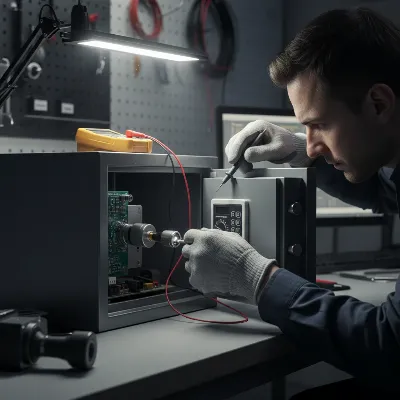 A professional safe technician carefully examining an electronic safe box with specialized tools.
Conclusion
Facing a locked safe box without immediate access can be daunting, but with the right knowledge and approach, you can navigate this challenge effectively. Understanding your safe’s type, assessing the urgency, and honestly evaluating your skills are the first critical steps. While some basic methods might work for simpler models, higher security safe boxes often necessitate professional intervention to prevent irreparable damage and ensure the safe remains functional. Always weigh the risks of DIY attempts against the expertise and cost-effectiveness of a certified safe technician. Prioritizing safety and the integrity of your valuables is paramount when seeking to open a locked Safe Box. Have you ever been in a situation where you needed to access a locked safe urgently?
Frequently Asked Questions
Can I really open a safe box myself without any prior experience?
For very basic electronic safes or older key locks, you might be able to troubleshoot issues like dead batteries or attempt simple lock-picking with online guides. However, for most modern or mechanical safes, professional expertise is highly recommended to avoid damaging the safe or its contents.
What are the risks of trying to open a safe box by myself?
The primary risks include irreparable damage to the safe’s locking mechanism, rendering it permanently unusable, or even destroying the valuable contents inside. There’s also a risk of personal injury if using power tools without proper training.
How much does it cost to have a professional open a safe box?
The cost varies significantly based on the safe’s type, security level, and the complexity of the locking mechanism. Simple electronic safe overrides might be less expensive than intricate manipulation of a mechanical dial safe or destructive entry methods like drilling. Always get a quote first.
Will a professional safe technician damage my safe to open it?
Reputable professional safe technicians will always attempt the least destructive method first. Many safes can be opened non-destructively by a skilled professional. Destructive methods are usually a last resort, discussed with you beforehand, and only employed when necessary.
How can I prevent losing my safe box key or forgetting the combination in the future?
For keyed safes, keep a spare key in a secure, separate location, or consider having a duplicate made. For electronic or dial safes, write down your combination/code and store it securely, perhaps with a trusted family member or in a separate bank safety deposit box, not directly with the safe.