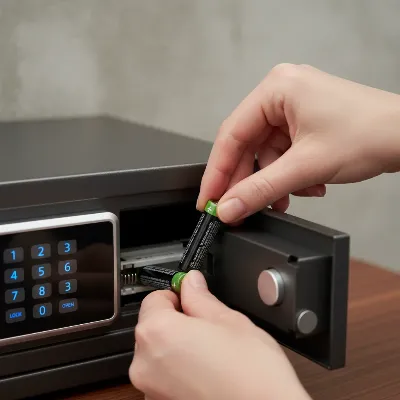
The security and accessibility of your valuables often depend on a small, easily overlooked component: the batteries in your digital safe. Imagine needing urgent access to important documents or cherished heirlooms, only to find your digital safe unresponsive. A dead battery is a common culprit, turning your reliable security into an unexpected lockout. This comprehensive guide will walk you through the process of replacing a dead battery in your digital safe, ensuring you can regain access and maintain continuous protection for your most valued possessions.
Understanding Your Digital Safe Box
Digital safes offer a convenient and secure way to protect valuables, relying on electronic keypads rather than traditional keys. These electronic locking mechanisms, however, require a steady power supply to function. When the batteries begin to deplete, the safe’s performance can falter, eventually leading to a complete lockout if not addressed promptly.
How Digital Safes Work
|
Our Picks for the Best Safe Box in 2026
As an Amazon Associate I earn from qualifying purchases.
|
||
| Num | Product | Action |
|---|---|---|
| 1 | SentrySafe Black Fireproof and Waterproof Safe, File Folder and Document Box with Key Lock, Ex. 14.3 x 15.5 x 13.5 inches, HD4100 |

|
| 2 | KYODOLED Cash Box with Combination Lock Safe Metal Money Box with Money Tray for Security Lock Box 7.87"x 6.30"x 3.35" Black |
|
| 3 | Yuanshikj Safe Box with Key Lock, Steel Security Lock Box, 0.23 Cubic Feet, 9.1" W x 6.7" D x 6.7" H, Small Hidden Safe for Home Office Cash Jewelry Storage (BLACK) |
|
| 4 | SentrySafe Fireproof Safe with Key Lock, Chest Lock Box for Home or Travel Secures Money, Documents, 0.18 Cubic Feet, 6.1 x 14.3 x 11.2 Inches, 1210 |
|
| 5 | DocSafe 5200°F Document Organizer with Lock, Upgraded Heat Insulated Fireproof&Water-Resistant Box 8 Layers File Organizer, Portable Home Travel Safe Storage for Important Documents and More |
|
| 6 | Amazon Basics Steel Security Safe and Lock Box with Electronic Keypad, Secure Documents Storage, Black, 0.5 Cubic Feet, 13.8" W x 9.8" D x 9.8" H, Removable Shelf |
|
| 7 | SentrySafe Fireproof Safe Box with Key Lock, Chest Safe with Carrying Handle to Secure Money, Jewelry, Documents, 0.25 Cubic Feet, 6.3 x 15.3 x 12.1 Inches, 1160 |
|
| 8 | Amazon Basics Steel Home Security Safe Box with Electronic Keypad Lock for Documents, Jewelry, Valuables, 1.8 Cubic Feet, Black, 13.8"W x 13"D x 19.7"H |
|
| 9 | KYODOLED Fireproof Document Box with Key Lock, Small Lock Boxes for Personal Items, Fire and Water Resistance, Fireproof Safe Box for Documents, Jewelry, Passport, Cash, 12.6'' x 8.3'' x 4.3'' Black |
|
| 10 | Amazon Basics Steel Security Safe and Lock Box with Digital Keypad, Easy to Use, Removable Shelf, Secure Cash, Jewelry, Documents, Black, 1.2 Cubic Feet, 16.9-x-14.6-x-10.6-inches (WxDxH) |
|
Most digital safes operate using a series of electrical components that power the keypad, display, and internal locking solenoid. When you input your code, the system verifies it and sends an electrical signal to retract the locking bolts. Without adequate battery power, this critical process cannot occur, rendering your safe inaccessible.
Signs Your Safe’s Battery is Dying
Recognizing the early warnings of a failing battery can prevent inconvenient lockouts. Common indicators include an unresponsive keypad, a dim or flickering display screen, or noticeable delays when entering your code. Many higher-end safes also feature audio cues, such as a series of beeps, or visual warnings like a low-battery icon, to alert you when power is running low. Cheaper models, however, might offer no warning at all, making sudden inaccessibility the first sign of trouble. Regular battery checks and proactive replacement are crucial to avoid these situations.
Essential Tools and Materials
Before you begin, gather the necessary tools and materials. Having everything on hand will make the replacement process smoother and quicker.
What You’ll Need
- New, High-Quality Alkaline Batteries: Always use fresh, reputable brand batteries. The specific type (AA, AAA, or 9V) will depend on your safe model.
- Small Screwdriver (Phillips or Flathead): Required for safes with a battery compartment secured by screws.
- Override Key: If your safe has a manual override, keep this key accessible (never store it inside the safe!).
- Paperclip or Similar Thin Object: Some keypad covers have a small release hole that requires a thin tool to press.
- Dry Cloth: Useful for cleaning battery contacts if any corrosion is present.
Step-by-Step Battery Replacement Guide
The method for replacing a digital safe’s battery varies depending on its design. We’ll cover the three most common scenarios.
Method 1: Batteries Behind the Keypad
This is the most straightforward method, common for many home and office safes where the battery compartment is externally accessible.
- Locate the Battery Compartment: The battery compartment is typically found directly behind or beneath the keypad. It might be a sliding cover, a panel secured by a small screw, or a cover with a release button accessed by a small hole. For sliding covers, gently push or slide the cover in the direction of an arrow. For screw-secured panels, use a small screwdriver to remove the screw. If there’s a small hole, insert a paperclip or a pen tip to press the internal release button while sliding or turning the cover.
- Remove Old Batteries: Once the compartment is open, carefully remove the old batteries. Note their orientation (+/-) as you do so. If you observe any powdery residue or corrosion on the battery contacts, gently wipe it away with a dry cloth.
- Insert New Batteries: Place the fresh, high-quality alkaline batteries into the compartment, ensuring the correct polarity (+/-) matches the markings inside. Incorrect installation can prevent the safe from powering on.
- Secure the Compartment and Test: Close the battery compartment securely, re-inserting any screws or sliding the cover back into place until it clicks. Test the safe by entering your code. The keypad should light up, and the safe should unlock normally.
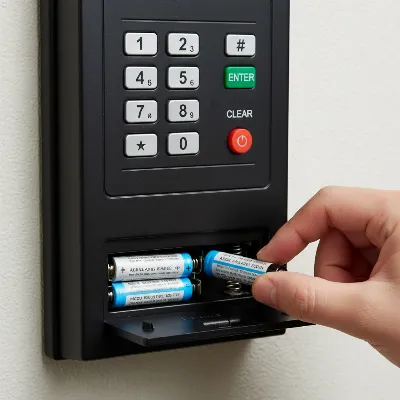 Digital safe keypad with battery compartment open, showing AA batteries being replaced.
Method 2: Using an Override Key
Some digital safes have a manual override key, particularly if the main batteries are located inside the safe door.
- Locate and Access the Override Lock: The override keyhole is usually discreetly hidden behind a removable panel or cover on the safe’s exterior, often near the digital keypad. Use a small screwdriver or your fingers to gently pry off this cover.
- Open the Safe with the Key: Insert the override key into the exposed keyhole and turn it to unlock the safe. Simultaneously turn the safe’s handle or knob to open the door. Remember, the override key provides direct mechanical access, bypassing the electronic lock entirely.
- Locate Internal Battery Compartment: With the safe door open, the battery compartment will be accessible on the inside of the door. It may be a small box with a cover that slides off, unclips, or is secured by screws.
- Replace Batteries and Re-secure: Remove the old batteries, noting their orientation. Insert new high-quality alkaline batteries, ensuring correct polarity. Close the battery compartment securely.
- Test and Reset (if necessary): Keep the safe door open and test the digital lock with your code. Some safes may require you to re-enter your code or perform a quick reset procedure after battery replacement, especially if the power was completely drained for an extended period. Refer to your safe’s manual for specific instructions if your code doesn’t work immediately.
Method 3: Emergency External Power (9V Battery)
This method is for safes where the internal batteries have died, and there’s no override key, or the keyhole is not readily accessible. These safes feature external contact points to temporarily power the system.
- Identify External Contact Points: Look for two small metal terminals (often labeled with a plus and minus sign or simply two distinct metal dots) on the safe’s keypad or a small cap on the side of the electronic lock. These are designed for an external 9V battery.
- Connect a 9V Battery: Take a fresh 9V alkaline battery and firmly press its terminals against the corresponding contact points on the safe’s keypad. You may need to hold it in place throughout the next step.
- Enter Code and Open Safe: While holding the 9V battery in place, enter your security code on the digital keypad. The temporary power from the 9V battery should activate the lock, allowing you to open the safe.
- Access and Replace Internal Batteries: Once the safe is open, disconnect the 9V battery. The main battery compartment will be located inside the safe door. Proceed to remove the old batteries and insert new high-quality alkaline batteries (typically AA or AAA), ensuring correct polarity.
- Test the Safe: Close the internal battery compartment, and with the safe door still open, test the digital lock with your code to ensure it’s functioning correctly on its new internal power supply.
> “Always have a fresh 9V battery readily available. It’s an indispensable tool for regaining immediate access to a digital safe when the internal batteries unexpectedly fail.” – John Smith, Certified Locksmith Specialist
Choosing the Right Batteries for Your Safe
The type and quality of batteries you use can significantly impact your safe’s performance and reliability.
Recommended Battery Types
For nearly all digital safes, high-quality alkaline batteries are the recommended choice. They provide a stable and consistent power output necessary for electronic locking mechanisms. Common sizes include AA, AAA, and 9V, depending on your specific safe model. Always check your safe’s user manual for the exact requirements. Investing in reputable brands like Energizer MAX, Duracell Coppertop, or Panasonic can prevent premature battery failure and leaks.
Batteries to Avoid
It is crucial to avoid rechargeable batteries in digital safes, as they often do not maintain a consistent voltage, which can interfere with the safe’s electronics. Similarly, refrain from using non-alkaline batteries (like carbon-zinc) or mixing different battery brands or old and new batteries together. Such practices can lead to inconsistent power delivery, leakage, corrosion, and potentially permanent damage to the safe’s circuitry, which is typically not covered by warranty.
Troubleshooting Common Issues After Battery Replacement
Even after replacing batteries, you might occasionally encounter issues. Don’t panic; most problems have simple solutions.
Safe Still Won’t Open
If your safe remains unresponsive after installing new batteries, start by rechecking the battery installation. Ensure each battery is firmly seated and correctly oriented according to the polarity markings (+/-). A loose connection or incorrect placement is a frequent oversight. Next, clean the battery contacts with a dry cloth; dirt or slight corrosion can impede electrical flow. If the problem persists, try replacing the batteries with a completely fresh set from a different pack or brand. Sometimes, even new batteries can be faulty. If all troubleshooting steps fail, it might indicate a more complex issue with the safe’s electronics, at which point contacting the safe manufacturer’s customer support or a professional locksmith is advisable.
Maintaining Your Digital Safe’s Battery Life
Proactive maintenance is key to ensuring your digital safe remains reliable and accessible for years to come.
Best Practices for Longevity
The most effective way to extend your digital safe’s battery life and prevent unexpected lockouts is to replace batteries annually. Even if your safe shows no signs of depletion, a routine replacement mitigates risks. For frequently used safes or those storing critical items, consider changing them every six months. Always store any override keys externally in a secure, accessible location, never inside the safe itself, as this defeats their purpose in an emergency. Additionally, avoid placing your safe in areas with extreme temperature fluctuations (below 0°C or above 50°C), as this can negatively impact battery performance and lifespan.
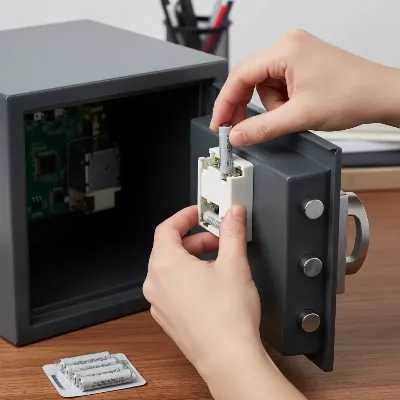 Hand replacing alkaline batteries in a digital safe, emphasizing regular maintenance.
Conclusion
Replacing a dead battery in your digital safe is a routine maintenance task that is crucial for maintaining the security and accessibility of your valuables. By understanding the different battery access methods, using the correct high-quality alkaline batteries, and following a proactive replacement schedule, you can effectively prevent inconvenient lockouts. Always keep your override key in a separate, secure location and be aware of the signs of low battery power to avoid any interruptions to your safe’s dependable operation. Don’t let a simple battery issue compromise your peace of mind—take control of your safe’s longevity today. What essential items are you protecting, and how often do you check your safe’s battery status?
Frequently Asked Questions
What kind of batteries do digital safes use?
Most digital safes use high-quality alkaline batteries, typically AA, AAA, or 9V, depending on the model. It is strongly recommended to avoid rechargeable or non-alkaline batteries, as they can cause performance issues or damage due to inconsistent power output.
How often should I change the batteries in my digital safe?
It’s a best practice to replace your digital safe’s batteries annually, even if there are no signs of depletion. For safes that are used frequently or store critical items, consider replacing the batteries every six months to ensure optimal performance and prevent unexpected lockouts.
Will my safe’s code be reset if the batteries die?
In most modern digital safes, the security code is stored in non-volatile memory and will not be lost if the batteries die completely. However, some older or simpler models might lose the code after prolonged power loss. Always check your safe’s manual for specific information.
What if I’ve lost my override key?
If you’ve lost your override key and your digital safe’s batteries are dead, opening the safe can be challenging. In this scenario, your best course of action is to contact the safe manufacturer’s customer support or a certified professional locksmith who specializes in safes. They may have specific tools or methods to open your safe without the key.